


Ecuadorian ex-VP Jorge Glas Faces Malnutrition Death Risk
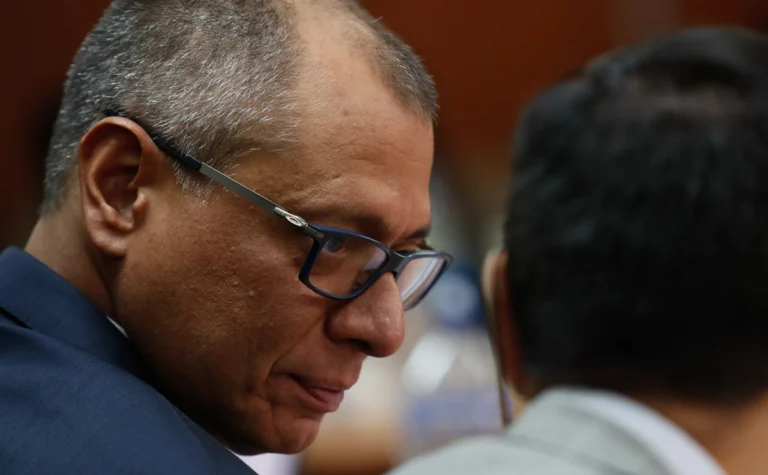
(FILE) The defense jurist emphasized that the physical deterioration of Jorge Glas is progressive. Photo: EFE.
April 1, 2026 Hour: 8:32 pm
🔗 Comparte este artículo
The former Vice President of Ecuador, Jorge Glas, is at risk of death due to malnutrition in the maximum-security prison as his lawyer, Sonia Vera, declared today.
Jorge Glas, a prominent political figure in Ecuador, faces a rapidly deteriorating health situation while incarcerated. The Ecuadorian ex-VP defense, Sonia Vera, affirmed that Glas has lost nine kilograms in three months, suffers a severe psychiatric condition, and endures psychological torture through family isolation and lack of medicines.
Jorge Glas, a prominent political figure in Ecuador, faces a rapidly deteriorating health situation while incarcerated.
RELATED: Ecuador: Judge Denies Release From Prison to Former VP Jorge Glas
Sonia Vera, a member of his international defense team, publicly denounced his critical state in a video shared on her social media profile, stating, “I am watching him die.”
This alarming assertion comes as state agents reportedly documented Glas’s condition within the Public Health Ministry’s Health Care Registry Platform system, indicating official awareness of his declining health.
Text reads: “I post this video with the permission of @JorgeGlas. What I have seen in recent weeks can no longer be hidden or distorted. In the face of circulating misinformation, it needs to be said clearly: the new corrective habeas corpus does not seek privileges. Seeks to guarantee a fundamental human right: prevent Jorge Glas from dying of malnutrition in state custody.”
Health Report: Isolation, Psychological Torture
According to detailed reports presented by the defense, a nutritionist confirmed on February 10 that Glas had experienced a significant weight loss, shedding nine kilograms in merely three months. Despite a specific dietary regimen being prescribed, its implementation remains neglected.
Vera highlighted the State’s obstruction of a comprehensive medical evaluation, citing the prohibition of basic medical instruments into the correctional facility, effectively impeding proper diagnosis and treatment.
The former Vice President presents a grave psychiatric condition, a direct consequence of his previous incarceration in facilities marked by massacres. He requires 45 daily doses of over 22 different pharmaceuticals; however, the provision of these crucial medications is alarmingly inconsistent.
The defense underscores that Jorge Glas is subjected to psychological torture and complete isolation, with family visits prohibited since December 2024. His condition is further aggravated by constant surveillance, which severely restricts his ability to communicate freely and privately, deepening his sense of vulnerability and isolation.
Right to Defense Violated
Sonia Vera pointed to the egregious violation of the right to defense, specifically mentioning the lack of confidentiality during legal meetings. Glas has been denied access to his national lawyers since his transfer to that prison, severely limiting his legal assistance and ability to mount an effective defense.
An essential corrective habeas corpus hearing is scheduled for next April 2, a petition initially filed on February 9. This legal recourse seeks to compel the Ecuadorian State to guarantee minimum living conditions, access to vital food supplements, and adherence to the prescribed medical diet.
“We are not asking for a privilege or impunity”, Vera emphasized, “we are asking them not to let him die of hunger.”
Text reads: “Today, together with @GabrielaEsPais and @mviniguez2, we spoke to the international press. One by one, we told you the facts that led us to this point: Assault on the Mexican embassy, kidnapping and torture of Jorge Glas, Expulsion of journalists and media purchases, Disappearance of Joshua, Ishmael, Nehemiah and Steven Medina, Public stoning of the judges of the Constitutional Court, Imprisonment, humiliation and torture of the Mayor of Guayaquil, Proscription of opposition political movements and Advance of elections.”
Political Persecution Context
Sonia Vera underscored that Jorge Glas’s plight, beginning with his initial incarceration in 2017, is part of a protracted pattern of political persecution. This persecution, she explained, is characterized by the arbitrary use of the penal system against him. The jurist recalled that Glas is the sole Ecuadorian citizen to have ten pronouncements from international organizations in his favor, all concurring on the vulnerability of his fundamental rights.
The defense narrated that, amidst profound legal insecurity, Glas sought diplomatic asylum in the Mexican Embassy in Quito in December 2023. This asylum was formally granted on April 4, 2024. However, in a move widely condemned internationally, Ecuadorian police forces raided the diplomatic mission on April 5 of the same year to apprehend the former Vice President, an act that violated international law and diplomatic conventions.
Vera reiterated that her client remains under the custody of a “persecutory State” that disregards critical legal precedents, which includes the nullification of evidence in the Odebrecht case by the Supreme Court of Brazil and Interpol’s refusal to issue red alerts against him, further illustrating the questionable legal basis of his continued detention. In this scenario, international defense has formally requested the extension of provisional measures to the Inter-American Court of Human Rights, urging the international community not to ignore the case.
For Vera, the upcoming habeas corpus on April 2 represents a crucial opportunity for the state to stop what it describes as an imminent risk of death in custody.
Author: Laura V. Mor
Source: Agencies